Saturday, May 30, 2015

Qatar World Cup


migrant qatar


I can barely believe the news coming from Qatar.   And I can't comprehend the minimal response from much of the world.  In this world some lives are worth more than others.  It comes down to that.  Countries that have money and power are able to use people from poorer places, to use them up as though they were disposable.  The sports and entertainment of the powerful are simply more important then the lives and deaths of the impoverished.

Reuters


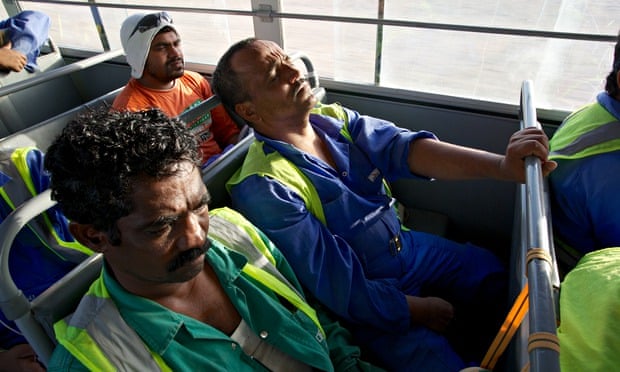
You don’t have to look far to get a pretty clear vision of what has been happening as Qatar, an ultra-wealthy, smallish Middle Eastern country about the size of Connecticut that has won the bid to host the World Cup in 2022.  The stories coming from the construction of the stadiums are horrific.  We don’t know how many people have died in the construction of Qatar’s stadiums.  That in itself is a serious issue.  We do know that over 400 Nepalese migrant workers have died on building sites in Qatar. 

Migrant workers Qatar World Cup


Workers from India, Sri Lanka, Bangladesh and other countries have been dying by the hundreds.  Their deaths are often unexplained or attributed to accidents or cardiac arrest (heart attack).  Such terms thinly veil the fact that these people have been worked to death.  Every government, every soccer fan, everyone should be outraged. 

Despite inquiries, studies, criticism, recommendations to allow for a safe and healthy work environment for these impoverished migrant workers, Qatar continues to drag its feet, hoping that the stories of misery will simply die down and that the world turn its head in a different direction.  

While building for the London 2012 Olympics, not a single worker died.  Not one.  England wouldn’t stand for the torturous conditions under which the migrants work in Qatar.  Qatar has the richest per capita income in the world.  The entire world.

#1 Qatar

When we consider the great numbers of deaths and injuries in these building sites, it lessens the impact.  When we read 4,000 ( as the projected number of deaths) it is just a big amount.  The number itself obscures the humanity.  Each one of those 4,000 is a child born to parents with brothers sisters.  Every one of that number is a human being who has loved and laughed and cried.  Just like us.  Most of those who went to Qatar had the dream of sending money back home to provide for the loves in their lives. 

It is only when we know the stories of their lives that they become real to us.  While they were born far away and have lives far different from our own, those migrants are us.  They are our brothers because they are human. 

This single story of a man (from the UK’s The Guardian)  helped me to understand the humanitarian crisis (what my friend Alan calls the genocide) that is happening in Qatar.

The Observer has learned of the horrific case of Noka Bir Moktan, a 23-year-old who was said to have died of "sudden cardiac arrest" in October 2013, although photos of his corpse show he suffered a collapsed chest, apparently consistent with ill-treatment.
Moktan's family come from a poor village in Nepal's remote hill district of Ilam. His elderly father borrowed 175,000 rupees (about £1,000) to pay for his passage and agency fees to Qatar, in the hope that he would be able to send some of his earnings home. The money, was borrowed from a loan shark and was supposed to be reimbursed by Moktan's Qatari employer, but this did not happen. The family now fear that the loan shark will demand that Moktan's two sisters, aged 14 and 16, who were collateral for the loan, be sent to work in brothels in Mumbai to pay off the debt.

And this isn't really a story.  It is a shallow summary of a man who gave his life to benefit his family.  

The number of deaths, is numbly called a grim statistic.  Life and death should not be referred to as statistics as it cheapens the stories of their lives, the loves they left behind, the children and dreams.  A report I read in The New Republic states that at the current rate, more than 4,000 migrant workers will die by the time Qatar puts on the 2022 World Cup.   

How can we even think about the term – current rate?  We aren’t talking about the stock market or test scores or inflation.  As soon as these stories began surfacing, there should have been an end to it.  There should never have been a current rate.  Every country with a team competing in the 2022 World Cup should have refused to allow a single player to enter that country, let alone to compete in a stadium built on the blood and bones of immigrant workers.  Instantly.  Unequivocally.  But that is too simple.  Because in this world the poor are worth less.

There is so much more to this story, of course.  Corruption.  FIFA.  Blatter (the re-elected president of FIFA described the conditions of the workers as "infractions" involving a marketing company).  But what we must always think about is that under every statistic or rate or ridiculous fool using a euphemism for murder are the lives of humans.  Just like us.

Sunday, May 10, 2015

Mother's Day 2015


I miss my mom.  It comes and goes, this feeling of missing her.  There are some days when I barely think of her at all.  Others, when I see something she’s written or look through a leaded glass window or lampshade that she lovingly created, when I think of her and smile.  Then there are days when I just miss her.  When I’d love to call her on my way home from work, or drive up to her house in the NC mountains and spend the weekend with her, or play her a new song on guitar.  She would listen, my mom.  She would really listen. 

So the other day, when my second graders were writing their own cards and letters to their moms, I missed her in that selfish way; that way that is all about me.   Because for so many years I would write that letter along with my kids. While my students were busy writing about being thankful for their moms being their when they are sick, I would write about being thankful for our childhood memories.  While my kids were thanking their moms for making them food and getting them their favorite clothes or toys, I would write my own love letter reminding my mom of just how much she meant to me.  For the past three years, I haven't been able to do that. 

When we were going through my mom's few remaining things, I found a manilla envelope marked Keepers From Tim.  I think every letter I had ever written to her was in that fat envelope.  Along with years worth of Mother's Day letters and cards.

Yesterday was her birthday.  She would have been 89.  When she was looking death in the face and the Hospice person was there at my sister Ruthie’s house explaining what the transition would be like, my mom said something to the effect of, I’m 86 years old.  I’ve had a good life.  You think I need to live to 87?  The Hospice worker cried.  Saturday, she would have been 89.  And for some reason, this revolving around the sun, this human-created calendar to mark where we are I our orbit, and these special days we are meant to celebrate, Mother’s Days and birthdays, make me miss her in a way that hurts my heart. 


Yesterday, Ruck’s birthday, I was in the yard watering plants.  I heard this frantic cheeping and saw a rustle in the leaves in the natural area beyond our year.  A beautiful brown thrasher was swooping low around me.  She was putting herself between the thin chirping/rustling and me.  She flew up and circled my head within a foot of my face.  I could have reached out and grabbed her.  She knew it and I knew it.  Then out from under a bush came a little fledgling.  


It sort of hop-walked.  It hadn’t yet developed its flight feathers and had tiny, down-like feathers sticking up from its head in a mohawk.  This little thing was at its most vulnerable.  It was clearly unafraid and as I took out my phone to take a picture, it hopped right up to me, much to the consternation of its mother.  I was so taken by this.  That mother thrasher was risking her life for this little one.  She was putting herself directly between her fledgling and what she perceived to be great danger.  How selfless.  How brave.  And, of course, it made me think of my mom.


That little scene also made me think of this other wonderful mother in my life.  Heidi Mills.  The mother of my children.  Heidi who works many extra consulting jobs, countless extra hours to pay for our son’s college education, who calls or texts them almost every day. Who, when she knows they are coming home, buys their favorite foods, and prepares their favorite meals.  Heidi, who when she knows they are sad or in pain, when they have been laid low by life’s trials, feels their pain and sorrow as if it were her own.  Who still puts letters from their college congratulating them on good grades up on the refrigerator.  Heidi is a mother who spared no expense materially or emotionally to bring up those two little babies to become the good men they are now.  Time, love, resources, love, faith, love. 

She is fierce and feminine, kind and dedicated.  She has a hunger for justice and laughs out loud.  She is brilliant and sweet, gracious and gentle.  Talented, modest, beautiful inside and out.

And She gives us all the greatest gift of all.  Love.  As I woke up this morning, feeling her warmth next to me; as I laid quite still to listen to her breathing, I was especially aware of how much I love this good woman.  My best friend.  This good mother. 

I miss my mom this Mother’s Day.  I missed my mom on her birthday.  But my own family is blessed to have this Heidi Mills in our lives.  I am so grateful.

Saturday, April 11, 2015

Shame on Franklin Graham


“I like your Christ, I do not like your Christians. Your Christians are so unlike your Christ.”  Gandhi

The face of Gandhi in old age—smiling, wearing glasses, and with a white sash over his right shoulder


Franklin Graham. 

If you are a Christian, you probably feel pretty strongly one way or another about Franklin Graham.  Take his recent facebook rant:

Listen up--Blacks, Whites, Latinos, and everybody else. Most police shootings can be avoided. It comes down to respect for authority and obedience. If a police officer tells you to stop, you stop. If a police officer tells you to put your hands in the air, you put your hands in the air. If a police officer tells you to lay down face first with your hands behind your back, you lay down face first with your hands behind your back. It’s as simple as that. Even if you think the police officer is wrong—YOU OBEY. Parents, teach your children to respect and obey those in authority. Mr. President, this is a message our nation needs to hear, and they need to hear it from you. Some of the unnecessary shootings we have seen recently might have been avoided. The Bible says to submit to your leaders and those in authority “because they keep watch over you as those who must give an account.” Hebrews 13:17

Truly spoken like a privileged white guy who doesn’t get pulled over for the color of his skin, the clothes he wears, the condition of his vehicle, the music he plays.  Spoken like a man who, if he ever was pulled over (or rather his driver) would feel nervous about keeping his hands in plain sight, about having to ask permission to reach into the glove box to get vehicle registration.  Spoken like a guy who has never had to live with racial bias or the threat of mistreatment by white police officers.  Spoken like a guy who probably doesn’t even know a Black person who has had to face an unjust system. 

It sounds like Franklin Graham believes that if you don’t want to shot by police, you should stop being Black.  

The mark of a good teacher, it seems to me, is the ability to empathize, to be able to put yourself in another's shoes, to see the world from another's perspective.  Entitled Franklin does not seem to have that ability.

Fascinating that Franklin says that we should obey authorities blindly, that unnecessary shootings could have been avoided by people (read: Blacks) simply laying face down on the pavement with their hands behind their backs would have avoided these horrifying events.  It is the Blacks fault because they didn’t obey.  Because they resisted.  Because they ran. 

They should simply OBEY.  And that Franklin invokes the B-I-B-L-E makes it the truth.  Because slinging the Bible around means you are speaking the WORD of GOD.  Right?  Because Franklin believes that FRANKLIN’S WORDS=GOD’S WORDS. 

That’s what Jesus did, right?  He blindly obeyed authority because it told him to in the B-I-B-L-E. (Hebrews is a New Testament book, which relied heavily on Old Testament quotes.) 

NOT! 

It was only because Jesus disobeyed the law that he demonstrated that he was greater then those laws.  He hung out with the unsavory, he interceded in the lawful stoning death of a woman accused of adultery (They were saying this, testing Him, so that they may have grounds for accusing Him.  But Jesus stooped down and with his finger wrote on the ground.  But when they persisted in asking Him, he straightened up and said to them, He who is without sin among you, let him be the first to throw a stone at her."  John 8:7 ), he healed the sick on the Sabbath, he flipped over the tables of the money changers in the temple (And Jesus entered the temple and drove out all those who were buying and selling in the temple, and overturned the tables of the money changers and the seats of those who were selling doves. And He said to them, "It is written, 'MY HOUSE SHALL BE CALLED A HOUSE OF PRAYER'; but you are making it a ROBBERS' DEN"   Matthew 21:12).  The authorities were ticked at all of these and many more of his actions and words that revealed them (and those laws) as hypocritical.  Good thing too.


Many other great leaders who knew that the way to change wrong practices, practices that defied logic and righteousness, was to stand up to authority.  Indeed that is how most of the greatest changes in our cultures have occurred – by standing up to injustice.  How about the Sons of Liberty and the American Revolution?  There was some disobedience there.  How about Gandhi and his salt march – the beginning of the end of Britain’s wrongful imperialistic rule over India?  Lots of disobedience.  How about those who opposed slavery?  It was completely legal at the time.  Martin Luther King Jr.?  Rosa Parks and the other strong, brave, beautiful Civil Rights leaders who led our country out of oppression of minorities?  (Not to say that the battle for a free and equal society is over).  If not for courageous, strong souls who stand up for injustice, there would effectively be no change. 

graham


I remember Billy Graham.   He was my wife’s grandmother’s hero.  He was an evangelist too.  But he wasn’t just a Christian leader.  He was a Christ like leader.  Sadly, his son Franklin gives Christians a bad name.  Shame on him.

Sunday, April 5, 2015

Mr. Rogers Neighborhood

Heidi found this post on Facebook and insisted that I watch.  I love Fred Rogers.  I used to try to make it home to watch Mr. Roger's Neighborhood with my boys when they were little .  I think I enjoyed him as much as they did.  It takes a few minutes to watch, but I defy you to watch the whole thing and not tear up.   

I found an old post about Mr. Rogers from my archive.  I wrote this about 5 years ago.  He was such a simple, complex, loving, honest, caring, straightforward guy.  


Last week I was looking for a quote by Fred Rogers. This was for a presentation at a big conference. I had read this quote before. It has to do with using what we learn about language and mathematics and how those powerful tools may be used for good or evil.

It took a while to find it, but along the way I ran across many wonderful ideas penned or spoken by the amazing Mr. Rogers.The guy was brilliant. His words were simple but elegant, easy to understand but deep.
The search for that quote reminded me of the time when my own boys were really young and we would watch Mr. Rogers Neighborhood when I got home from school. This was before we had cable and the only channels we could pull in on the old rabbit ears were ABC, NBC, CBS and Public Television. Thank God for ETV for Kids. Watching Mr. Rogers with my boys was a treasure.His messages of love and self-worth were not just for the very young.

After all those years, reading his words again rejuvenated me. They reconnected me to that special time when Devin was about 3 and Colin 1 ½. Both boys in diapers and nothing else. That was such a special time for us. Such an intimate sharing. After the show we might hold on and watch Magic School Bus or head outside to romp around near the lakeshore.

All of this came flooding back as I read through quote after quote.What a smart guy. What an inspiration. Little kids hooked on Mr. Rogers were lucky. Grown-ups hooked on Mr. Rogers (and few of us would actually admit it out loud) were lucky too.

Finally I found the one I was looking for. When I first rediscovered the words it was pretty late. Heidi was already asleep. I read it aloud to myself to see if it would work to begin my presentation. I copied it word for word from the computer screen. For the next several days I carried it with me, pulling it out occasionally to practice reading it so when the time came to read it aloud to a big bunch of professionals, I wouldn’t choke up.

You know with the No Child Left Behind legislation and pressure on teachers and students to perform well on high stakes standardized tests, Fred Rogers words help me to keep it all in perspective. It’s not enough to merely be able to read. I want my students to laugh when they read something funny and to cry when they read something sad or touching. I want my students to read like they can’t wait to share something they have learned or well-crafted words they have read. I want my students to be moved by what they read.

Likewise, it’s not enough to merely be able to write. I want my students to be compelled to write, to convince, to share who they are and what they know. I want my students to choose their words wisely and to be able to move others by what they write.
So Fred’s words were perfect. They said, in few words, what it took me many to say. It is an honor and a privilege to share them with you.

"It's easy to convince people that children need to learn the alphabet and numbers. How do we help people to realize that what matters is how a person's inner life finally puts together the alphabet and numbers of his outer life? What really matters is whether he uses the alphabet for the declaration of war or the description of a sunrise, and his numbers for the final count in Buchenwald or for the specifics of a new bridge" (Fred Rogers)

Friday, March 20, 2015

We Pray For Children


I read this poem a bunch of years ago.  I don't know it's history but I use it often when I speak to teachers about what our job really is.  I am a teacher of little kids.  I don't just teach math or reading or social studies.  I teach children.  This poem by Ina Hughes reminds me.

We pray for children
who put chocolate fingers everywhere
who like to be tickled
who stomp in puddles and ruin their new pants
who sneak popsicles before supper
who erase holes in math workbooks
who can never find their shoes

rain-boots-and-puddle

And we pray for those
who stare at photographers from behind barbed wire
who can't bound down the street in a new pair of sneakers
who never "counted potatoes"
who are born in places we wouldn't be caught dead
who never go to the circus
who live in an x-rated world


We pray for children
  who bring us sticky kisses and fistfuls of dandelions
who sleep with the dog and bury goldfish
who hug us in a hurry and forget their lunch money
who cover themselves with band-aids and sing off key
who squeeze toothpaste all over the sink
who slurp their soup


And we pray for those who never get dessert
who have no safe blanket to drag behind them
who watch their parents watch them die
who can't find any bread to steal
who don't have any rooms to clean up
whose pictures aren't on anybody's dresser
whose monsters are real

We pray for children
who spend their allowance before Tuesday
who throw tantrums in the grocery store and pick at their food
who like ghost stories
who shove dirty clothes under the bed and never rinse out the tub
who get visits from the tooth fairy
who don't like to be kissed in front of the carpool
who squirm in church or temple and scream in the phone
whose tears we sometimes laugh at and whose smiles can make us cry

And we pray for those
whose nightmares come in the daytime
who will eat anything
who have never seen a dentist
who aren't spoiled by anybody
who go to bed hungry and cry themselves to sleep
who live and breathe but have no being

We pray for children who want to be carried and for those who must
for those we never give up on 
and for those who don't have a second chance

For those we smother... and for those who will grab the hand of 
anybody kind enough to offer it.
                     Ina J. Hughes

At school we have a moment of silence every day.  "Please pause for a moment of silence," says the child who reads the announcement.  It used to mean nothing to me.  It was just this little moment where I would mentally prepare for the school day ahead.  Now I pray for children.

Wednesday, March 18, 2015

The Hat


The Hat

I wrote this little piece last year when my third grade class was working on memoir.  


It was gray when I woke up; misty, foggy, cool – no, cold. Not a great day for the beach. It was chilly and gusty. The kind of day that made my ears ache when I went swimming. Michigan City, Indiana. 1968. I was 11 years old.

In early summer the downtown area was home to a bazaar, a fancy name for giant sidewalk/garage sale. All of the shops had racks and shelves of bargains outside. People were invited to bring their used clothing and household items and set up tables to sell their wares.

My mom was a bargain hunter. With seven children she had to be. My brothers and sisters decided to stay home that day. I’m sure they had better things to do. I wanted to go with my mom.

This was the kind of day my brothers and sisters loved to swim. There was a cold northwest wind blowing and the waves on the beach would be enormous, way over my head. I loved these days as well. There was danger involved in swimming these waves. They towered over you, threatening to squash you into the sand if you didn’t catch them just right. If you went out too far, the undertow could snatch you up and pull you out.

This latter danger was for people who didn’t grow up on the beach. Almost every day that the wind whipped up from the northwest during swimming season someone along the beach would be swept away. Chicago, Gary, Miller Beach, Porter Beach, the Indiana Dunes State Park, Beverly Shores, Michigan City. We would read about it in the paper, occasionally see a helicopter flying by on these days. When we did we knew someone had probably died. We pretty much knew what we were doing. We never ventured out far. Still there was the danger.

As for being smashed into the sand if we didn’t get on top of the waves we were body surfing, that happened all the time and we routinely walked back into the house with bad scrapes and sand rashes from this hazard. Those wounds were all right. Those scabs would become badges of bravery.

I got ear aches on these days. I could have worn ear plugs but that would be a sissy thing to do. So I chose to go with my mom to the sidewalk sale. With six brothers and sisters, I didn’t get much time alone with her anyway so this would be my chance.

The bazaar was very busy. Vendors, crowds of people, the smell of sausages and popcorn, laughing, bargaining, little kids clinging to their mothers’ dresses, occasional babies crying. Teenagers, parents, old people.

My mom let me wander around by myself for a while. There was a huge clock tower so, even though I didn’t have a watch, I could see to meet her at noon. I only had a quarter with me so I was just looking. I’ve always been intrigued by crowds, always been a people watcher even as a kid.

There was a table of old used clothes in front of St. Anne’s church. They were musty and wrinkled and piled on the tables not folded neatly or hung on racks as the clothes were in front of the stores. The poorer people were drawn to this area because the prices were so low. There seemed to be something for everybody. They were practically giving the clothes away.

One old man was wandering between the rows of tables. I’m not sure why I was drawn to him especially. He was one of so many. But I watched him carefully for the next few minutes. His clothes were very worn. Gray pants frayed at the cuffs and pockets. They were pleated pants. My mom would have called them trousers. Tired old jacket which could not have kept him warm on this chilly day. His fancy old dress shoes were terribly worn.  He needed a shave. His cheeks and throat were covered with short gray stubble.

He wore no hat and his head must have been cold. It was early summer, but that northwest wind… He was very bald and the gray fringe that surrounded his head was shaggy and blew in the cold gusty wind. He could have used a hat.

I wished that he had newer clothes. I wished he had a hat. In those few moments that our paths crossed I felt sad for him. I’m not sure why I remember him after all of this time, after all the years and distance; his windblown hair, his disheveled yet somehow classic clothes, his stubbly cheeks and the smile lines around his eyes. I don’t think I could pick him out of a lineup after all this time, but I remember the feel of him.

I wished he had a hat. It was chilly. His head, shiny on top, was blotchy from the cold. He must have been freezing with his threadbare jacket and his thin, worn pants.

As he walked down the long tables in what I thought of as the poor peoples’ section in front of the church, he would pick up one item then another. He would pick up a woman’s scarf, turn it over in his hands and, almost as if he were having a conversation with himself, would shake his head and return it to its place at the table.

Finally he came to an area on one table with hats. I was relieved. He needed one. There were stocking caps and baseball style caps, earmuffs and old fashioned felt hats like the one my dad wore to church. The old man stopped at these, meticulously searching through them for just the right one.

Why was I concerned about him finding the right hat? I had never seen him before, would probably never see him again. But I was mesmerized, silently urging him to find a comfortable hat to warm his bald head.

He picked up a gray felt hat with a wide brim. I think it’s called a fedora. He tried it on and it fit snugly. He sort of wiped his hand around the brim in an automatic gesture. I had seen people do that kind of thing in movies. They were rich people or gangsters.

The hat looked great on him. A lady at the end of the table was eying him suspiciously. She had a gray metal box in front of her – the money box. Perhaps she thought he would walk away with  the hat without paying for it. The old man didn’t look at her. I could tell that he was pleased with the hat. He had this dreamy faraway look in his eyes like he was remembering something from long ago. His fingers went around the brim again. He smiled a small stubbly smile, a satisfied smile, the smile of a younger man. It was the look of one who has found a jewel.

The money lady continued to glare at the little man. He reached up and took the hat off. There was a little piece of masking tape on the band inside the hat. A price tag. I couldn’t make it out but the man stared at it unbelieving. I could see his disappointment.

He reached into his pocket and pulled out some money. All change. It surely wasn’t enough. I could tell by the look on his face. I wanted to buy it for him. I only had a quarter. It wouldn’t help much.

With a look of quiet disappointment and even embarrassment the old man put the hat back on the table - slowly, almost reverently. His shoulders drooped and he shuffled softly away. The money lady smirked.

All these years later I wonder why the image of the old man stays with me. Certainly I have witnessed sadder moments. On the news. In the papers. In books. So many tragic stories with greater magnitude. Why this man? So long ago and so far away.

Perhaps in a way this little story has served to make me aware of the small sufferings all around me. Perhaps this little memory reminds me of all the rich blessings in my own life. I am so blessed. I pray that I never take it for granted.